
Different Diets in a Relationship: Make Dinner Work Without Policing Each Other
Dinner does not require matching plates. Discuss ingredients, shopping, cooking, and family meals without turning food preferences or medical needs into a loyalty test.
You want dinner to be an ordinary part of the evening. Instead, every meal starts another negotiation: what counts as a full meal, which ingredients can enter the kitchen, who cooks twice, and whether declining a dish means rejecting the person who made it.
Different diets in a relationship are not one single problem. Taste, ethics, religion, health, access, and family habits can all shape what someone eats. A useful arrangement begins by understanding which difference you are actually managing. It does not require either partner to adopt the other's diet, and it does not make one person the permanent cook for two incompatible menus.
This guide is about sharing food decisions as adults. It is not a nutrition plan, allergy management protocol, or weight-management program. When a health condition affects eating, use qualified clinical guidance for that condition rather than negotiating medical needs as if they were preferences.
Separate Preferences, Commitments, and Health Needs
Ask each other to describe the boundary in ordinary language. “I do not enjoy mushrooms” is different from “I do not eat animal products,” which is different from “I have a diagnosed food allergy.” You do not need to rank these reasons by moral worth to recognize that they require different practical responses.
For a preference, you might discuss substitutions or separate toppings. For an ethical or religious commitment, the questions may include shopping, utensils, preparation, and whether particular foods are welcome in the home at all. For a health need, ask what the person's clinician has advised and what they want you to understand. Do not demand medical records as the price of taking a stated need seriously.
The NHS distinguishes food allergy from food intolerance and notes that allergic reactions can be serious.[1] This distinction matters because “just try a little” is not a reasonable response to an allergy concern. Do not hide ingredients, test someone without their knowledge, or decide that removing a visible ingredient makes a dish appropriate. Follow the person's clinical plan and seek qualified advice about uncertainty.
Some boundaries will not fit neatly into one category. A food may connect someone to family while also conflicting with a partner's beliefs. Listen to both meanings before jumping to logistics. If religious practice is central, the guide to discussing faith in daily household life goes further than this meal-planning article.
You may discover a real limit: one person wants a home without certain foods, while the other does not want to live that way. A shared recipe cannot settle that disagreement. Be honest about the household each person can accept rather than treating persuasion as the missing cooking skill.
Choose a Meal Structure Instead of Cooking by Argument
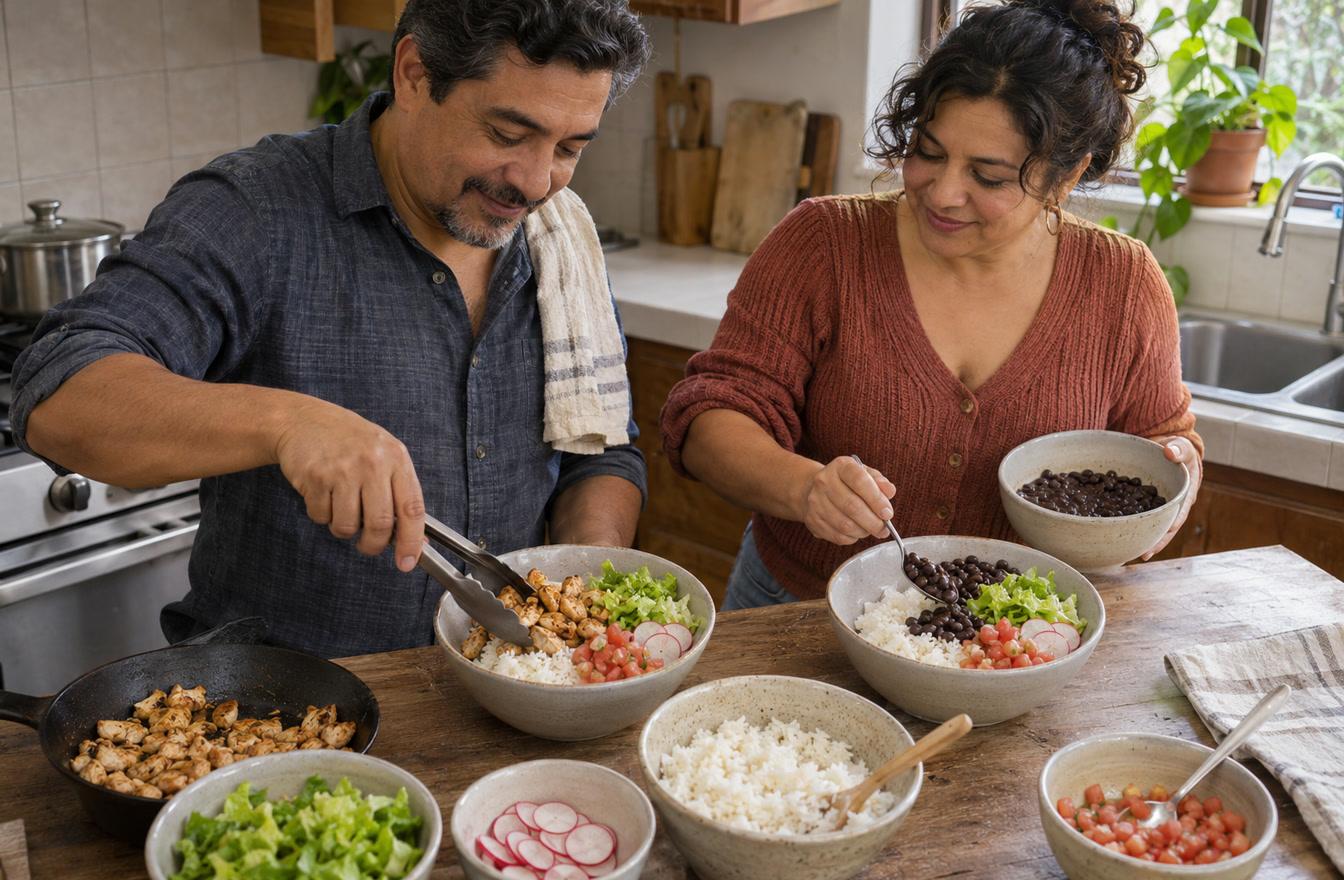
Start with meals you both already enjoy and can eat. You are looking for a repeatable structure, not a perfect menu. One option is a shared base with separate additions: rice and vegetables with different proteins, a soup served before separate toppings are added, or a meal assembled from several clearly identified components.
That structure works only when the ingredients and preparation are appropriate for both people. Shared components may be unsuitable for a particular allergy or religious practice. Do not use the idea of a common base to skip checking the stock, sauce, oil, garnish, or preparation method. Ask rather than assume.
Another option is alternating cooking nights with an agreed standard: the cook prepares something both people willingly eat, and optional extras remain each person's responsibility. A third is cooking separately but sitting down together when convenient. Eating different dishes does not mean you cannot share a meal; eating at different times does not automatically mean you lack connection.
Avoid making the same person customize every plate. If one partner wants an extra component, decide who buys it, cooks it, and cleans up. Likewise, a person with dietary restrictions should not automatically carry all the planning because they know more about the ingredients. Both people can learn what is necessary while respecting limits on what either will prepare.
Make a short backup list for tired evenings. Include options that fit your budget and actual access to shops or delivery. A backup meal should reduce pressure, not become another expectation of homemade perfection. If there is no shared option that night, separate simple meals may be more workable than another debate over who is being difficult.
Make the Shopping List Precise Enough to Use
“Get something I can eat” can leave the shopper guessing. Agree on a few specific staples and how substitutions will be handled. If a usual item is unavailable, should the shopper send a message, choose from an agreed alternative, or leave it off the list? Medical and religious requirements may make improvisation inappropriate.
Read labels for the relevant purpose rather than relying on a familiar color, a brand name, or a broad marketing phrase. The NHS food-allergy guidance recommends checking labels and restaurant menus and telling restaurant staff about an allergy.[1] A shopping agreement is useful only if it respects that verification work rather than treating it as fussiness.
Do not assume that products with similar names are interchangeable. NHS guidance explains that lactose-free dairy products can still be dairy, while plant-based alternatives are a different category.[2] That is a concrete reason not to choose a product solely because it says “free from” something. If you are unsure whether an item fits a particular health requirement, do not guess.
The NHS also notes that a balanced vegan diet requires planning, including attention to nutrients that may need fortified foods or supplements.[3] This supports taking food planning seriously. It does not mean a partner should prescribe supplements, monitor intake, or treat every dinner as a nutrition inspection. Individual needs belong with the person and an appropriate healthcare professional.
Discuss costs without attaching blame to the eater. Compare actual purchases, waste, and convenience needs. If one person's products cost more, decide how shared spending will work instead of silently treating those costs as frivolous. Equally, do not assume every preferred specialty item must be purchased from a shared budget without discussion.
Share the Work Without Policing the Plate
Cooking includes more than standing at the stove. Someone notices supplies, checks ingredients, decides what to make, shops, stores food, prepares it, and cleans up. A couple can appear to alternate cooking while one person still performs most of that coordination.
Name the full sequence for a few ordinary meals. If one person cooks, the other might own shopping and cleanup, provided that division is genuinely workable. If both cook separately, decide how you share kitchen time and equipment. Avoid a system where the person with the more flexible schedule becomes permanently available to prepare the other's meals.
Respect also means leaving the other person's body out of the negotiation. You can discuss shared groceries without commenting on weight, judging portions, or requiring explanations for every snack. A relationship food agreement should not give either person authority to supervise what the other eats.
Consider a hypothetical disagreement: one partner wants meat at dinner, and the other does not want to cook it. A possible arrangement is a mutually acceptable shared dish, with the first partner preparing an addition separately if both accept that in the kitchen. That is not the only fair answer. The important part is that neither person silently expects the other to perform work they have declined.
If food conversations become distressing, involve persistent restriction, or connect to an eating-disorder history, avoid turning the issue into an informal couple challenge. Seek appropriate professional support. You can ask what kind of practical help is welcome without making yourself the judge of what your partner should eat.
A usable division of labor leaves room for low-capacity days. Someone who usually enjoys cooking may be tired, ill, or busy. Agree on a fallback rather than interpreting one simple meal as a withdrawal of care. The aim is reliable nourishment and respectful choices, not a nightly demonstration of devotion.
Handle Restaurants and Family Meals Before You Arrive
A restaurant choice is easier when you discuss constraints before making the reservation. Each person can suggest places they actually want to visit, then check whether the food and preparation can meet relevant needs. Do not assume a menu label answers every question, particularly where an allergy is involved.
When a health need matters, communicate directly with the venue and follow clinical advice about what information to request. If the venue cannot confidently accommodate the need, choose another plan rather than pressuring your partner to improvise because everyone is already hungry. You can feel disappointed about changing plans without making the person responsible for that disappointment.
Family meals add another layer: hospitality may be expressed through a dish someone cannot or does not eat. Discuss who will communicate with the host and what information is necessary. Offer a practical suggestion if you want to, such as bringing a suitable dish, but do not volunteer the restricted eater to cook for everyone as the automatic solution.
A useful message might be: “We are looking forward to seeing you. These are the ingredients we need to avoid. Could we check the menu beforehand?” Keep health details private beyond what is needed. A partner can support the conversation without making a joke about picky eating or apologizing for someone else's body or beliefs.
Travel makes these choices less predictable. If you need a broader planning process, agreeing on a trip with different preferences can help you discuss pace and budget as well as food. Here, focus on having a realistic meal option rather than assuming spontaneity will work equally well for both people.
Repair the Specific Mistake and Change the Process
Mistakes happen: someone buys the wrong product, forgets a preference, or serves a dish with an unexpected ingredient. Start with what happened and its consequences. An innocent shopping error still needs correction; a deliberate attempt to conceal an ingredient is a different and more serious breach of choice.
If an allergy exposure or reaction is possible, follow the person's clinical action plan and seek appropriate medical help. Do not make reassurance, blame, or finishing the conversation the priority. This article cannot assess the seriousness of symptoms or tell you that waiting is safe.
For an ordinary preference mistake, acknowledge it without requiring the other person to comfort you: “I forgot to leave that topping separate. I will make sure you have another option.” Then change the process. Put the ingredient note where the shopper will see it, agree on a substitution rule, or stop using a meal structure that repeatedly creates confusion.
Do not convert every mistake into a permanent character verdict. Also do not call a repeated disregard a misunderstanding indefinitely. The relevant question is whether the person takes the stated boundary seriously and participates in making the kitchen workable.
After a few shared meals, ask what became easier and what still creates unnecessary labor. Keep the meals that work, revise the shopping rule that fails, and drop arrangements that require one person to eat against their wishes. Dinner does not need to make you identical. It needs to leave both people fed, informed, and free to choose.
FAQ
Can a Vegan and a Meat Eater Share Meals?
They can if they find food and a kitchen arrangement both freely accept. Shared dishes with separate additions are one option, but not if they conflict with someone's ethical limits or medical needs. Discuss buying, preparation, and cleanup rather than assuming one person will handle every variation.
Should the Person With More Restrictions Do All the Cooking?
Not automatically. Relevant ingredient knowledge can be shared, and tasks can be divided according to capacity and willingness. A restriction does not make someone responsible for all household meals. Equally, neither partner should be expected to prepare food they have clearly declined to handle.
What if My Family Thinks My Partner Is Being Rude?
Explain the practical boundary before the meal when possible, without sharing unnecessary private information. Appreciate the hospitality while making clear that eating a particular food is not a required expression of gratitude. Offer a feasible alternative rather than asking your partner to violate a health need or personal commitment.
Is It Okay to Eat Different Dinners?
Yes, if that arrangement works for both people. You can share the time without sharing every ingredient, or eat separately when schedules require it. The issue to discuss is whether the work, cost, and kitchen access are acceptable, not whether matching plates prove closeness.
Research References
- 1. NHS (2026). Food Allergy. Supports distinguishing allergies from preferences and checking ingredients with appropriate medical guidance.
- 2. NHS (2023). Dairy and Alternatives in Your Diet. Explains the difference between lactose intolerance, milk allergy, lactose-free dairy, and dairy alternatives.
- 3. NHS (2026). The Vegan Diet. Supports deliberate nutritional planning without turning a partner into a dietary supervisor.
Get the next essay.
One careful essay, every other Monday.